
|
|
December 10, 1925: WGHB in Clearwater signed on the air with a six hour broadcast. The station was licensed to 1130 kHz, using 500 watts. The first broadcast was heard as far away as Alaska. The station's first transmitter was previously used by WSB in Atlanta. WGHB was situated in the Fenway Motel, near Dunedin. The calls were the owner's (George H. Bowles) initials.
July, 1926: Ownership transfers to the Fort Harrison Hotel. January 9, 1927: WGHB switches to 850 kHz. January 31, 1927: Call letters changed to WFHH, in recognition of new owners. June, 1927: Ownership changes to the Clearwater Chamber of Commerce. June 15, 1927: WFHH moves to 820 kHz. July 27, 1927: St. Pete City Council approves for that city's chamber of commerce to buy half interest in WFHH. August 15, 1927: A two year effort to secure the calls WFLA is successful. WFLA intending to signify "West Florida." August 18, 1927: First agreement between Clearwater and St. Pete to divide station ownership is reached. October, 1927: Ownership is officially "split" between Clearwater and St. Pete. November 1, 1927: WFLA moves to 590 kHz with 750 watts. WSUN has the inaugural broadcast and shares time with WFLA. January 1, 1928: WFLA and WSUN move to 580 kHz. November 11, 1928: WFLA and WSUN switch to 900 kHz. November 15, 1929: A major reallocation of most Florida stations moves WFLA and WSUN to 620 kHz. May 9, 1932: WFLA and WSUN begins testing of the FIRST directional antenna in the U.S, designed by Raymond Wilmotte. January 23, 1941: WFLA moves to 940 kHz, WSUN stays on 620 kHz. March 29, 1941: WFLA moves to present-day frequency of 970 kHz.St. Petersburg Times, January 10, 1927: A trail of new accomplishment in radio broadcasting was blazed here Saturday when radio broadcasting station "WGHB" after exhaustive tests sent out its first daylight programs to the north.
Heretofore considered impractical because of the interruptive bombardment of static, the broadcasting program was sent out at 3 o'clock Saturday afternoon, eastern standard time, for a period of an hour. Reception was pronounced as perfect by radio engineers who cooperated with station "WGHB" in northern cities. Telegrams of the results achieved in northern cities poured into the radio station early this evening. Tests of the daylight broadcasting program have been carried on for the past two months by W. Walter Tison, engineer and announcer, assisted by Wally Wiley, assistant engineer, with cooperation from leading radio engineers of the nation, and as a result the daylight programs will be broadcast each afternoon throughout the winter until excessive static interruption in the spring makes the broadcast programs by daylight no longer possible, Mr. Tison said.St. Petersburg Times, August 16, 1927: Negotiations for two years were consummated here today with the announcement that the Clearwater radio station license had been renewed with the new call letters WFLA. Formal dedication of the station under its new letters was held with a special program tonight.
Notification of the new call letters was received today by the chamber of commerce from W.D. Terrell, chief of the radio division of the Department of Commerce, Washington. The letters intending to signify "West Florida" were formerly used for the station at Boca Raton, about 18 miles west of Palm Beach. Two years ago when the chamber of commerce leased the station from George H. Bowles, efforts were made to secure the WFLA call but Boca Raton had priority. Repeated attempts continued unsuccessfully until the new license was received today by Park B. Norton, president of the chamber of commerce, and W. Walter Tyson, directing announcer of the station.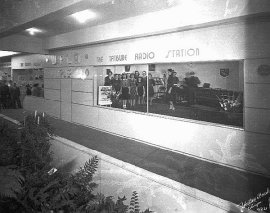
April 6, 1932 St. Petersburg Times: The eyes of the world are focused on WFLA Clearwater, where the directional antenna developed by Raymond Wilmotte, British authority on transmitting aerials, is being given its first real test.
If the Clearwater tests at Bayview are successful, stations along coastlines and in lake areas may be able to double their inland service areas by blocking waves which hitherto have gone out over the water and reflect them back to add their power to those regularly emanating inland, Walter Tison, station director said today.
"Experiments with the antenna show that it tends to act as increasing the power of a station without the transmitter's actually having greater wattage. For instance, a 1,000-watt station on a seaboard emanates waves in a concentrict (sic) circle of which the transmitter is the center. Naturally, half the waves go out to sea. By causing these waves to be reflected inland, the station becomes the equivalent to a 2,000-watt transmitter. Inland receivers pick up the regular 1,000-watt inland wave, and the reflected 1,000-watt sea wave," Tison said.
The new equipment has been installed by WFLA in an effort to receive a license for greater power from the federal commission who ordered the local station reduce her power last summer when it was found that WFLA was interfering with WTMJ, Milwaukee.
An excerpt from an October 28, 1927 St. Pete Times article: An increase in power from 500 to 750 watts for a period of sixty days has been granted to the St. Petersburg-Clearwater broadcasting station as a result of a conference held in Washington Thursday between the Federal Radio Commission and local representatives.
The new order gave WFLA at Clearwater a frequency of 690 kilocycles and an increase in power from 500 to 750 watts. The local delegation requested an increase to 10,000 watts.
Included in the brief presented to the federal commission was a request that the commission suspend an order that the local station share its time with a station (WDBO) in Orlando.
This article appeared in Broadcasting, Sept. 15, 1940:
Acquisition by WSUN, St. Petersburg city-owned station, of the facilities of WFLA, Tampa, with which it shares time on 620 kc., is provided under an agreement worked out between the two stations Sept. 10, subject to FCC approval.
The city of St. Petersburg would acquire the half-time facilities of WFLA for \$125,000, under authorization given at a council meeting Sept. 9.
The arrangement grows out of the action Aug. 28 of the FCC in granting the Tampa Tribune, principal owner of WFLA, a new regional assignment in Tampa on 940 kc. with 5,000 watts day and 1,000 watts night [Broadcasting, Sept. 1]. The grant, however, was conditioned upon the station divesting itself of its interest in WFLA, and the WSUN sale was worked out in compliance with that edict.
The Tampa and St. Petersburg stations have divided time for 13 years. Under the proposal W. Walter Tison, general manager of WFLA and the only individual owning stock in the station, will sell his 45% interest to the Tampa Tribune, which in turn will liquidate the Florida West Coast Broadcasting Co., passing its physical properties together with time on the air and its NBC-Blue contract to WSUN. Thus the latter station would become a fulltime NBC-Blue outlet on 620 kc. WSUN would continue to use the Bayview transmitter near Clearwater, installed by Mr. Tison in 1932, as the first directional station in the county.
The Tribune owns 55% of the common stock of Florida West Coast and all of the preferred stock. In the liquidation of the corporation, the Tribune would retain the call letters WFLA, subject to FCC approval for its new 940 kc. station. Mr. Tison will remain as general manager of this operation.
Upon completion of the new WFLA transmitter, to be located at Rocky Point about five miles from Tampa, the new station will become the NBC-Red outlet in the area.
In commenting on the sale, Mr. Tison said that while he was reluctant to sell his interest in WFLA, it nevertheless was an excellent manner in which to clear up one of the few outstanding division of time stations and that his effort was to cooperate by sale of his stock.
S. E. Thomason, publisher of the Tampa Tribune and the Chicago Times, announced that his company was relinquishing its present WFLA property, subject to FCC approval, at a figure less than two-thirds of cost. "We make this contribution to what appears to us to be a happy settlement of a part time radio operation that has been fraught with costly difficulties, both for WSUN and WFLA," he said.
Mr. Thomason explained that his new station would retain contractual arrangements for the Red network programs of NBC and relinquish its interest in Blue network programs now broadcast over WFLA. He said that arrangements are not completed but he understood NBC has indicated readiness to extend the Blue to WSUN.
